
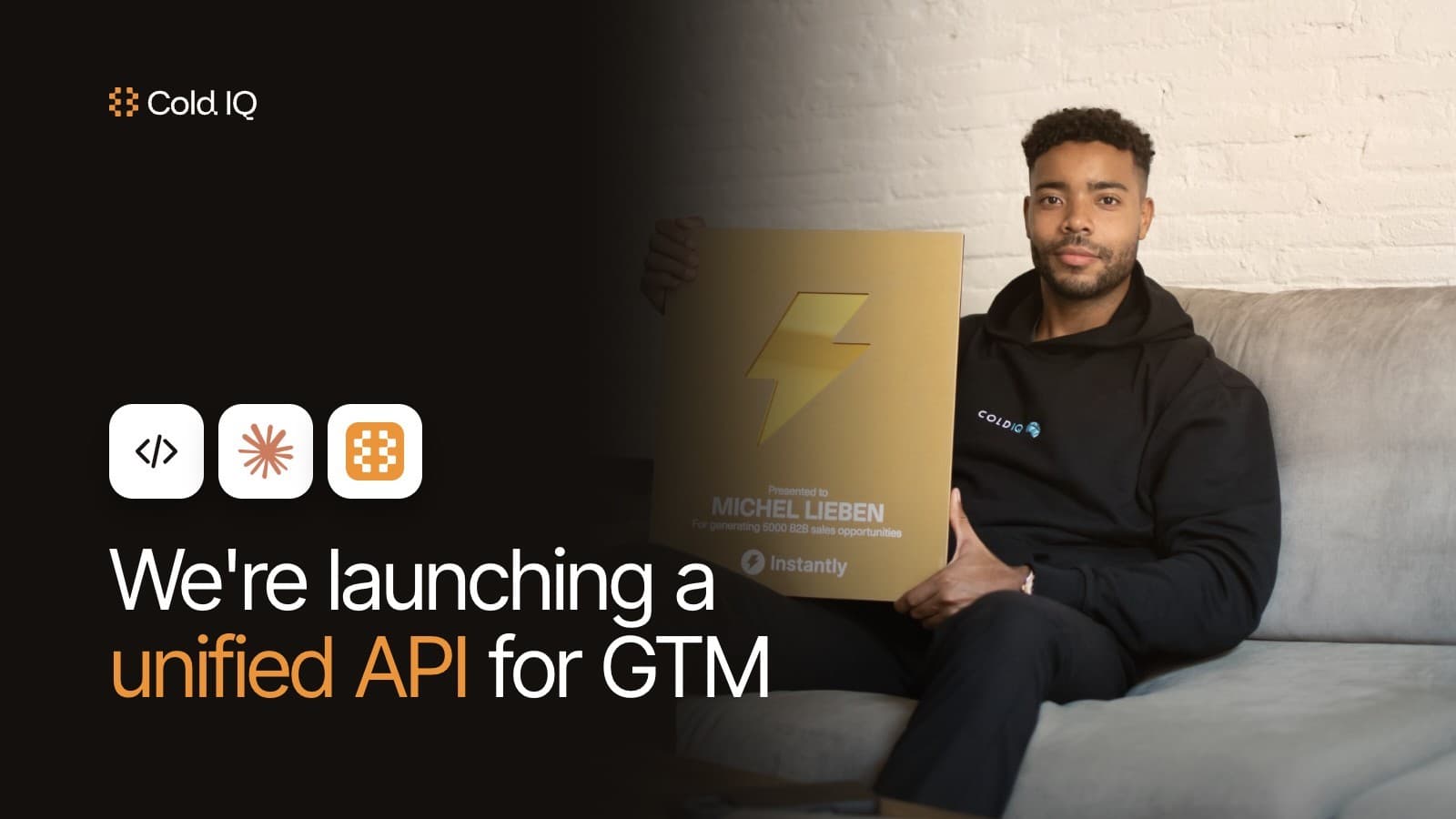
We're launching a unified API for running go-to-market through Claude Code.
It's the biggest bet of my career, and to go all in, I'm stepping away from the $7M ARR agency I spent the last three years building.
The agency is doing better than ever. ColdIQ has served 275+ B2B clients, sent tens of millions of emails, and generated more than $50M in revenue for the companies we work with.
So why put that down to start something new? Because the way go-to-market gets done is changing faster than the market realizes, and I want to build the layer the next generation of GTM teams will run on.
Here's what I'm seeing, why it pulled me out of a business I love, and what we're building.
1. The Best GTM Teams Already Ditched Their Tools
The best GTM engineers and agencies have already moved off tools and interfaces. They run on GitHub repos, terminals, and APIs instead.
This sounds extreme until you watch one of them work. Instead of clicking through a data platform, then a sequencer, then an enrichment tool, then a CRM, they describe what they want in plain language and let an agent execute it end to end. The interface is a command line. The output is a finished campaign.
Claude Code made this practical for people who aren't engineers. You can hand an agent a task, give it the right context, and it will chain together the steps that used to eat an afternoon. The teams that adopted this early are running the same volume of work with a fraction of the clicks.
The pattern is clear. The interface layer that defined B2B software for a decade is quietly becoming optional.
2. Why AI Agents Still Fail at GTM
Handing an agent a GTM task and expecting good work is the fastest way to be disappointed. The agent isn't the problem. The context around it is.
To make an agent genuinely useful for go-to-market, you have to feed it a lot before it does anything valuable:
→ GTM skills and the frameworks behind them
→ Best practices for list building, messaging, and deliverability
→ API keys for 8 to 12 different tools
→ Internal business context about who you sell to and why
→ Standard operating procedures your team already follows
→ Past campaign data so it learns what worked
Miss any of these and the output is generic. The agent will build a list that ignores your ICP, write copy that sounds like every other cold email, and skip the buying signals that make timing work.
This is the real bottleneck. The intelligence is available and cheap. The context that makes it perform is scattered across a dozen accounts, a few Notion docs, and the heads of your best operators.
3. What Running GTM Through One API Looks Like
Picture giving your system a single instruction:
"Build a list of software CEOs in London, at companies with 25 to 100 people, pick up who's in buying mode, draft 3 angles for messaging, and upload it to my sequencer."
That one sentence hides four separate jobs that normally live in four separate tools. When the context and the connections are already in place, the agent runs all of them without you touching an interface.
The first job is sourcing. Finding software CEOs in a specific city, at a specific company size, used to mean building a search inside a data platform and exporting the results. An agent with the right access does it from the instruction itself.
You can also identify the right decision-makers at target accounts here:
People Finder Tool
FIND PEOPLE
Type domains, select personas, fetch real contacts.
Paste a LinkedIn company URL or company domain and press Enter
Persona 1
Define specific job titles to target the right decision makers
The second job is timing. "Who's in buying mode" is where campaigns are won or lost. A list of 500 CEOs is worth far less than the 40 of them showing hiring signals, funding activity, or tech changes that suggest they're actively looking. Layering intent onto the list turns a cold outreach into a relevant one.
If you want to see which companies are actively researching solutions in your space right now, you can do it for free here:
Intent Signals Tool
Fields marked with * are required
Quick examples:
The third job is messaging. "Draft 3 angles" means the agent proposes distinct hooks based on your ICP and what you sell, so you're testing directions instead of staring at a blank page. Good angles come from context the agent already holds, not from generic prompts.
You can generate campaign ideas based on your ICP and content strategy in seconds, for free:
Campaign Ideation Tool
Enter your email to generate your campaign ideas.
The fourth job is delivery. Uploading the finished, enriched, angle-ready list into your sequencer is the last click, and even that disappears when the connection is wired in. The full path from idea to live campaign happens in one instruction.
4. The Shift Isn't Replacing Tools
Someone left a comment on my announcement that captured the whole thing better than I did.
The biggest shift isn't replacing GTM tools. It's replacing the person who has to stitch them together.
That person is real. On a GTM team they're the operator who knows which data source to use for which niche, how to set up the enrichment waterfall, where the buying signals live, and how to move a list from one platform to the next without breaking it. They're valuable and they're a bottleneck, because everything routes through them.
When the stitching becomes an API call, that changes. The knowledge doesn't disappear. It gets encoded once and runs on demand. The operator stops being the bottleneck and starts designing the system that does the stitching at scale.
This is the part that convinced me to leave. The agency taught me exactly what that stitching looks like across 275+ clients. The next step is turning it into infrastructure anyone can run.
5. What We're Launching
I'm building a unified API for running go-to-market through Claude Code. One connection that carries the skills, the tool access, the context, and the SOPs an agent needs to do real GTM work, so you can describe the outcome and let it execute.
It's the same operating system we used to generate $50M+ for clients, rebuilt so a team doesn't need an agency to run it. Early access includes onboarding with our GTM engineers, weekly working sessions, and a private community where you can go straight to the team building it.
Before any of that matters, it helps to know where your current GTM motion stands. You can see how your approach compares to the models the best teams are running:
GTM Report Tool
Leaving a business you built to its best year is uncomfortable. It's also the clearest signal I've had that the ground is shifting. The teams moving to repos, terminals, and APIs aren't waiting for permission, and I'd rather build the thing they run on than watch it get built.
If you're running GTM today, which part of your stack would you hand to an agent first?
---