

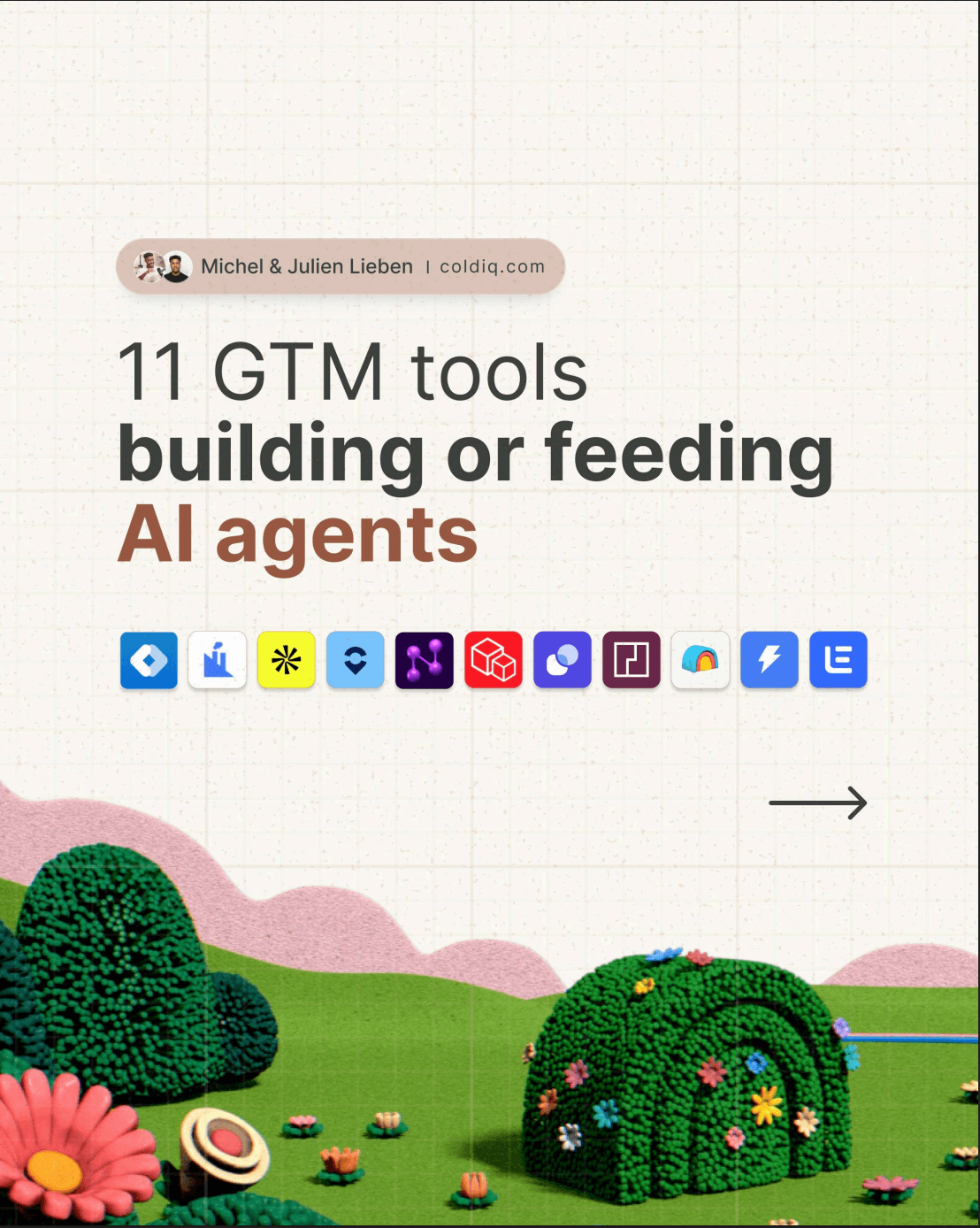
Claude Code for GTM is real now.
The bottleneck isn't the agent anymore. It's the tools the agent can call directly: contact databases, intent signals, enrichment services, sequencers, orchestrators.
If those tools don't expose a clean API or MCP server, the agent can't drive them, and the whole system stalls.
Julien spent hundreds of hours testing GTM platforms against Claude Code to see which ones are genuinely agent-ready and which still expect a human in the seat. Here are the 11 worth knowing about, split by whether they feed data into your agent, host the agent itself, or do both.
1. Data Feeds That Power Your Agents
These are the tools your agent calls when it needs more information than the prompt provides: company data, contact data, intent triggers. The bar is clean APIs, real coverage, and predictable latency.
CompanyEnrich
CompanyEnrich ships B2B company data APIs designed for agents and workflows. A single call returns firmographics, contact enrichment, and lookalike companies, so an agent can go from "find me 50 accounts similar to X" to a usable list without chaining three providers.
The lookalike endpoint is the differentiator. Enrichment APIs typically hand you data on a known company. CompanyEnrich's lookalike call gives you a structured way to find new ones that match.
LeadsFactory
LeadsFactory is a real-time LinkedIn data API for surfacing decision-makers. Its Waterfall Search auto-falls back to adjacent titles when the exact persona isn't there, which matters because agents otherwise return empty lists and stop.
The graceful degradation makes it a strong fit for agents building targeted lists at scale, where rigid persona matches break the workflow.
Apollo.io
Apollo.io just shipped an MCP server on top of its 275M+ contact database. Agents can search by persona, reveal contacts, and enrich on demand without writing a custom integration.
MCP support matters because it removes the friction between "I want my agent to use Apollo" and "my agent is using Apollo." The interface is standard, not bespoke.
Prospeo
Prospeo is a 200M+ contact database with free search endpoints and an API rebuilt specifically to make list enrichment effortless inside Claude Code.
The free-tier endpoints matter for prototyping. You can wire your agent to Prospeo, run real test queries, and only pay once you're ready to scale.
You can find verified email addresses for your target accounts here, for free:
Email Finder Tool
Your target's information
Fields marked with * are required
Enter just the domain (e.g., company.com) or paste a website URL
Please enter a professional email address
Please fill in all required fields
PredictLeads
PredictLeads is the freshest intent-signal source agents can ingest: hires, funding rounds, tech installs, news mentions, champion tracking. It was always API-first, so plugging it into Clay, Claude Code, or your own orchestrator is straightforward.
For agentic GTM, intent signals are the difference between cold outreach and timed outreach. Without them, your agent can hit anyone. With them, it knows who to prioritize this week.
You can see which companies are showing intent in your space right now, for free:
Intent Signals Tool
Fields marked with * are required
Quick examples:
2. Platforms For Building Agents
These are the platforms where the agent lives. They handle execution, state, and integration so you spend time on the agent's logic, not its plumbing.
Openmart
Openmart is the strongest local business data platform we've tested, and its new agent sits on top of 200M+ local businesses. It autonomously pulls verified emails and phone numbers, qualifies against your signal criteria, and hands the list off to your sequencer.
If your ICP is local businesses (clinics, restaurants, contractors), Openmart removes the bulk of the manual sourcing work that kills agentic flows in that segment.
Nooks
Nooks evolved from a parallel dialer into a full multichannel sales agent with a built-in AI sales coach. It reads live signals, drafts personalized copy, and re-tunes sequences while they run, instead of locking the playbook on day one.
The closed loop between signal, copy, and sequence makes Nooks one of the few platforms where the agent adapts mid-campaign rather than asking a human to intervene.
Relevance AI
Relevance AI is the programmable GTM platform we recommend when teams want to build and ship custom agents via Claude Code or Cursor. 100+ integrations across CRMs, email tools, and enrichment providers cover the data layer out of the box.
Built-in governance (audit logs, role-based access control) is what makes it usable in production environments, not just prototypes. The same agent that ran in a sandbox can ship to the team without rewriting the deployment story.
lemlist
lemlist embedded two agentic layers directly inside its sequencer: a live intent-signal layer and a personalized research layer. The AI tracks triggers per prospect and runs research before the sequence fires, so the first message is already context-aware.
For teams that want agentic personalization without building the agent themselves, lemlist is the lowest-friction entry point. The agent is the sequencer.
3. Orchestrators That Do Both
These tools straddle data and execution. They feed your agent with enrichment, and they let you build agents inside their platform.
Clay
Clay's new Builder Agent spins up workflows from a single natural-language sentence. Claygent still runs what we consider the best AI research layer on any URL, returning the exact data fields you specify into your table.
The combination is rare. Other platforms do data well or workflow well. Clay does both, which is why it shows up in every modern GTM stack we audit.
Instantly.ai
Instantly.ai's AI sales agent runs your inboxes, writes sequences, sends at peak times, and classifies replies automatically. The Supersearch agent doubles as a natural-language prospect-finder, so you can describe an ICP in plain English and get a list back.
For teams that want one platform handling both prospecting and sending, Instantly is the closest thing to a one-shot agentic outbound system today.
4. The Practical Playbook
The 11 tools above stack into a system, not a list. The four layers a working agent ends up using:
→ Data layer: CompanyEnrich, LeadsFactory, or Prospeo for contact and account data
→ Signals layer: PredictLeads for hires, funding, and tech triggers
→ Orchestration layer: Clay or Relevance AI to chain the steps
→ Execution layer: Instantly, lemlist, or Nooks for the actual outreach
The agent doesn't need all 11. It needs one tool per layer, each with an API the agent can call without a human in the loop.
If you want to understand where your GTM motion stands today and which agentic layers you should plug in first, see below how your current approach compares to these specialized models:
GTM Report Tool
---


