

Key Takeaways (TL;DR)
- The Hybrid Model is King: The best sales automation services blend advanced AI technology with human strategic oversight. Purely automated tools often lack the nuanced personalization needed to convert complex deals, while purely manual agencies can't scale efficiently. A hybrid approach delivers both quality and quantity.
- ColdIQ Leads the Pack: As a premier AI-powered agency, ColdIQ builds and manages your entire outbound sales engine - a hybrid done-for-you service that also ships its own GTM data API (40+ providers, 700+ endpoints), turning manual prospecting into a predictable source of qualified appointments.
- It’s About Systems, Not Just Tools: True sales automation is about building intelligent, repeatable systems that generate pipeline. It's more than just buying software; it's about integrating technology into a cohesive strategy that automates research, personalization, outreach, and follow-up.
- Focus on ROI, Not Just Cost: While some tools and services may seem cheaper upfront, the most critical metric is your return on investment. A high-quality, appointment-setting service that delivers convertible leads is far more valuable than a low-cost tool that requires significant internal resources to manage.
- Integration is Non-Negotiable: Your sales automation partner, whether a tool or an agency, must integrate seamlessly with your CRM (like Salesforce or HubSpot). This ensures a smooth workflow, prevents data silos, and creates a single source of truth for your entire sales operation.
A predictable flow of qualified leads is the foundation of every successful B2B company. However, sales teams are often bogged down by manual, repetitive tasks that drain their time and energy. According to a report from Salesforce, sales reps spend only 28% of their time actively selling. The rest is consumed by administrative duties, prospecting, and data entry. This is where the best sales automation services become a game-changer.
By taking over the tedious, top-of-funnel activities, sales automation empowers your team to focus on what they do best: building relationships and closing deals. But with a market full of software tools and specialized agencies, how do you identify the right partner? This guide breaks down the top players for 2026, comparing full-service sales automation agencies with powerful self-service tools to help you build a more efficient and effective sales engine.
Top Sales Automation Services: At a Glance
| Provider | Type | Best For | Key Differentiator |
|---|---|---|---|
| ColdIQ | Hybrid Agency + Product | B2B teams wanting done-for-you automation plus their own data API | Agency + GTM data API (40+ providers, 700+ endpoints); Elite Clay; ~2-week launch |
| Frontal | Agency (Service) | B2B companies wanting a complete "done-for-you" appointment-setting service. | End-to-end management of outbound campaigns, combining an AI-powered sales engine with expert human strategy. |
| HubSpot Sales Hub | Platform (Tool) | Teams already in the HubSpot ecosystem needing an all-in-one CRM and automation tool. | Seamless integration with marketing and service hubs, providing a unified view of the customer. |
| Persana AI | Platform (Tool) | High-volume sales teams needing deep personalization from signal-based selling. | Access to 700M+ contacts and 75+ buying intent signals for hyper-relevant outreach. |
| Clay | Platform (Tool) | RevOps and growth teams needing highly customized data enrichment and research. | Waterfall enrichment from over 150 data providers and AI agents for automated research. |
| SPOTIO | Platform (Tool) | Field sales teams that need to optimize territory management and in-person activities. | Location-verified activity logging, route optimization, and robust offline capabilities. |
| La Growth Machine | Platform (Tool) | B2B teams focused on multichannel prospecting across LinkedIn, email, and voice. | Advanced LinkedIn automation, including voice messages and intent data targeting. |
| Utmost Agency | Agency (Service) | Companies seeking to build scalable sales systems rather than just adding headcount. | Intent-driven sales systems that leverage automation. |
| Apollo.io | Platform (Tool) | Mid-market teams looking for a large contact database combined with outreach tools. | A massive B2B database (210M+ contacts) integrated with sequencing features. |
| Zapier | Platform (Tool) | Non-technical teams needing to connect disparate apps and automate simple workflows. | No-code automation with over 8,000 app integrations. |
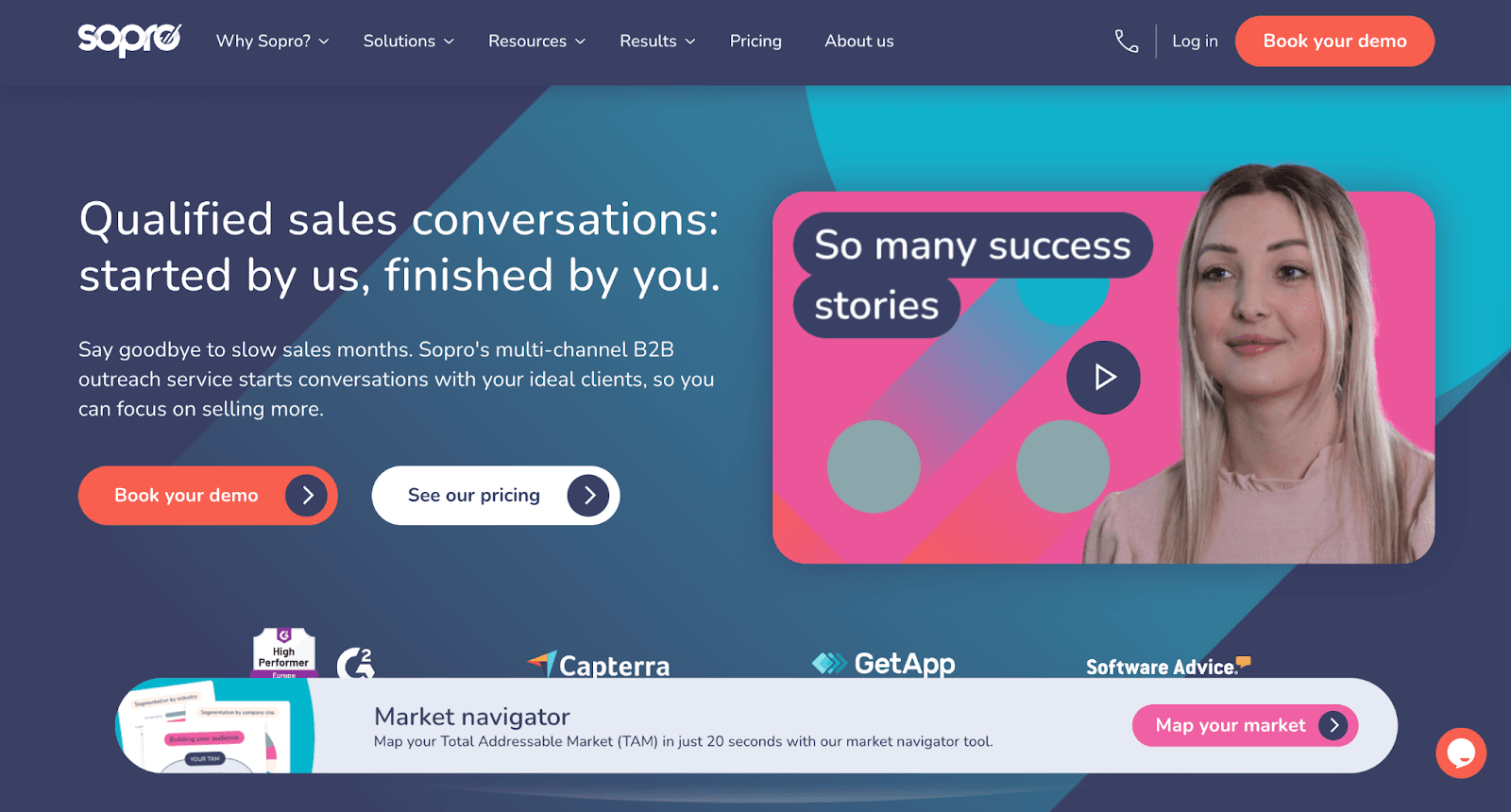
| Sopro.io | Agency (Service) | Businesses looking for a fully managed B2B lead generation service | Combines human expertise with advanced data analytics to deliver personalized B2B lead generation campaigns. |
What Is Sales Automation?
Sales automation is the use of technology to streamline and automate repetitive, manual tasks throughout the sales cycle. The goal is not to replace salespeople but to empower them by handling the time-consuming activities that distract from high-value interactions. This allows reps to dedicate more energy to strategic selling, relationship building, and closing deals.
Effective sales automation can manage a wide range of tasks, including:
- Prospecting and Lead Generation: Automatically identifying and gathering contact information for potential customers who fit your ideal customer profile (ICP).
- Data Entry and CRM Updates: Logging calls, emails, and meeting notes in your CRM without manual input.
- Personalized Outreach: Sending tailored email and social media sequences to prospects at scale.
- Lead Nurturing: Delivering relevant content and follow-ups to keep leads engaged over time.
- Scheduling: Automating the process of booking meetings and demos.
- Reporting and Analytics: Generating reports on sales activity, pipeline health, and team performance.
By building an automated system, you create a more efficient, consistent, and scalable sales process.
Why Sales Automation is Essential in 2026
The nature of B2B sales has grown more complex. Buyers are more informed, decision-making committees are larger, and competition is fiercer than ever. In this environment, sales teams can no longer afford to waste time on tasks that software can handle better and faster.
Research from McKinsey shows that automation can boost sales reps' selling time by up to 20%. This reclaimed time translates directly into more conversations with prospects, a healthier pipeline, and increased revenue.
Furthermore, teams that embrace automation are better positioned to succeed. A study noted by Persana.ai found that sales teams using automation were 61% more likely to exceed their revenue targets. These services are no longer a luxury for large enterprises; they are a fundamental requirement for any business looking to achieve sustainable growth. In 2026, the question isn't whether you should adopt sales automation, but how quickly you can implement a strategy that gives you a competitive edge.
Best Sales Automation Services in 2026
The sales automation landscape includes two main categories: "do-it-yourself" software platforms and "done-for-you" agencies. Here’s a breakdown of the top options that blend technology, strategy, and service.
1. ColdIQ

Overview:
ColdIQ is a hybrid: a done-for-you sales automation agency and a software company. On the agency side it has run outbound and GTM for 300+ companies and generated $50M+ in ARR for those clients, and as one of only four Elite Clay Expert partners globally it runs data enrichment and personalization at a depth most agencies cannot replicate.
On the product side, ColdIQ ships the ColdIQ Unified API - one key into 40+ data providers and 700+ endpoints for lead search, contact enrichment, email finding, and buying signals, callable as a REST API or an MCP server inside Claude Code. So the same infrastructure that powers its client work is available as a product your own team can build on.
Why It Stands Out:
ColdIQ delivers a complete, end-to-end sales automation service, not just a tool: dedicated infrastructure setup and warmup, billions of data points for targeting, Clay-based enrichment, and expert campaign management, with a first launch in about two weeks. Because it owns its data layer, clients can graduate to calling the same API directly as they scale.
Best For:
B2B companies that want to outsource top-of-funnel pipeline generation and receive qualified meetings, on data infrastructure the agency also sells.
Pros:
- Hybrid model: a senior done-for-you team plus its own GTM data API (40+ providers, 700+ endpoints).
- Elite Clay expertise (one of only four Elite Clay partners globally) for enrichment and personalization at scale.
- Signal-driven and account-based: outreach is triggered by intent data, not guesswork, and measured on SQLs.
- Fast setup: first campaigns typically go live in about two weeks.
- Deep credibility: 300+ clients served and a 150K+ operator network behind the playbooks.
Cons:
- Premium positioning: built for B2B, not B2C or ultra-low-budget, high-volume commodity work.
- Best fit for teams with a clear ICP and a real sales motion to feed.
- The self-serve API is newer (beta) and credit-metered on top of provider costs.
Pricing:
The done-for-you service runs on a custom monthly retainer, typically a 90-day pilot and then an ongoing partnership. The self-serve ColdIQ Unified API is separate and starts at $99/month (2,000 credits), with Pro at $199 and Scale at $499; unused credits roll over for three months.
2. Frontal
Overview:
Frontal is a sales automation agency, and one of only four Elite Studio Clay Experts globally, using advanced data enrichment to personalize outreach at scale. It maps a client's ICP and buying signals, handles the full technical setup including domain procurement and warmup, and launches campaigns with a roughly two-week speed-to-market.
Best For:
B2B companies wanting a done-for-you service that pairs AI-driven workflows with human strategy to book qualified meetings.
Pros:
- Elite Clay expertise for data enrichment and hyper-personalization at scale.
- A 10+ tool stack for accurate sourcing and clean enrichment.
- Roughly two-week speed-to-market on first campaigns.
- Full-transparency reporting via weekly live dashboards.
Pricing:
Custom monthly retainer, typically starting with a 90-day pilot and scaling to a longer partnership. No long-term lock-in beyond the pilot.
3. HubSpot Sales Hub
Type of Service: Platform (Tool)
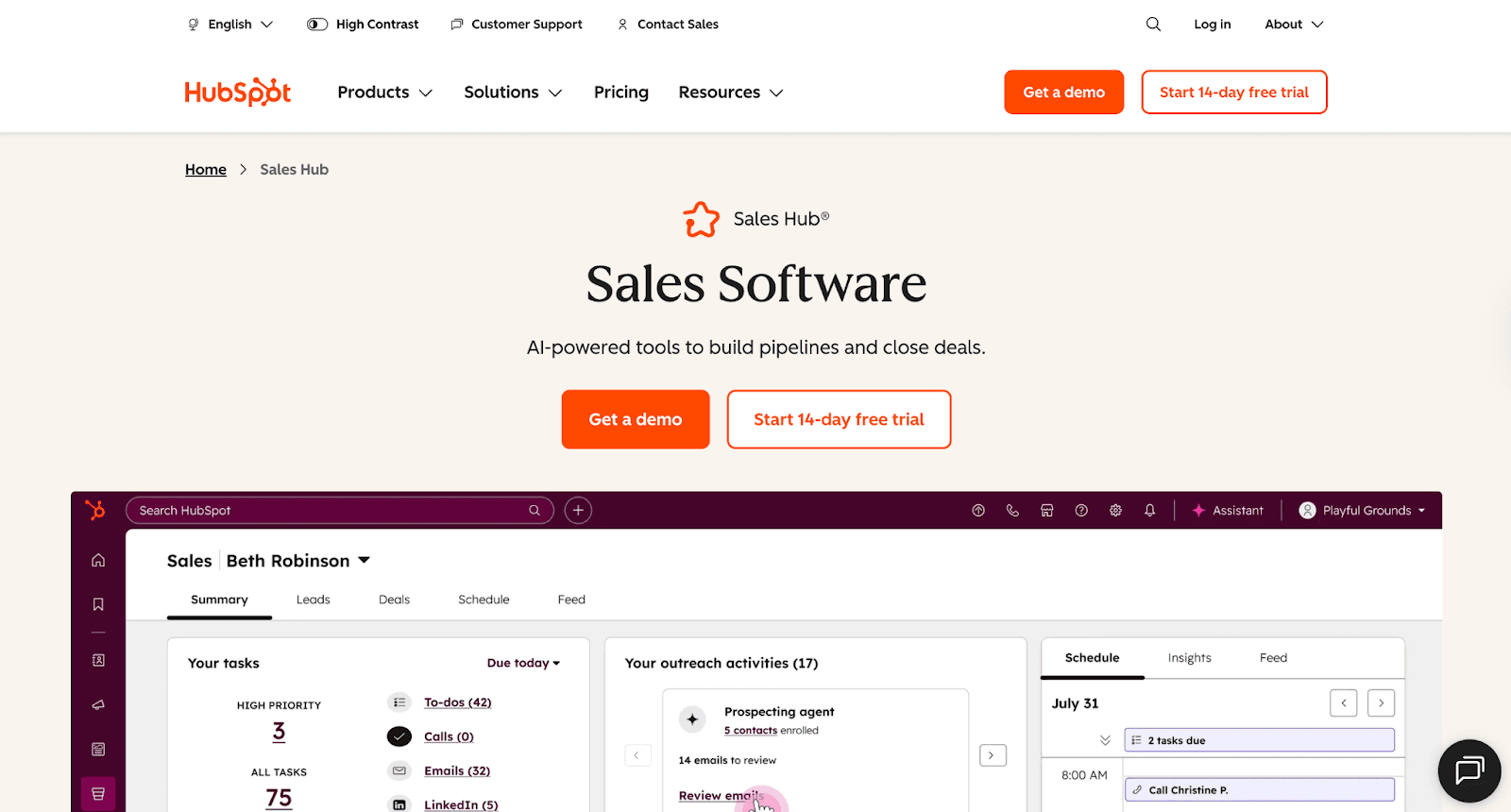
Best For: Sales teams of all sizes that are already using or plan to adopt the HubSpot ecosystem for their CRM, marketing, and service needs.
Why It Stands Out: HubSpot Sales Hub is renowned for its user-friendly interface and powerful, integrated features. It centralizes sales activities within a single platform, making it easy to automate tasks, track deals, and gain a unified view of the customer journey. Its workflow builder allows teams to automate lead rotation, task creation, and email sequences with ease. For companies invested in the HubSpot ecosystem, its seamless integration with the Marketing and Service Hubs is a significant advantage, eliminating data silos and creating a cohesive operational backbone.
Pros:
- Intuitive and easy-to-learn interface.
- Deep integration with HubSpot’s marketing and service tools.
- Strong automation features for email sequences, task management, and lead rotation.
- Comprehensive reporting and analytics to track performance.
Cons:
- Advanced features are locked behind more expensive tiers.
- Can become costly as your team scales and requires more seats.
- Less flexible for companies not fully committed to the HubSpot ecosystem.
4. Persana AI
Type of Service: Platform (Tool)
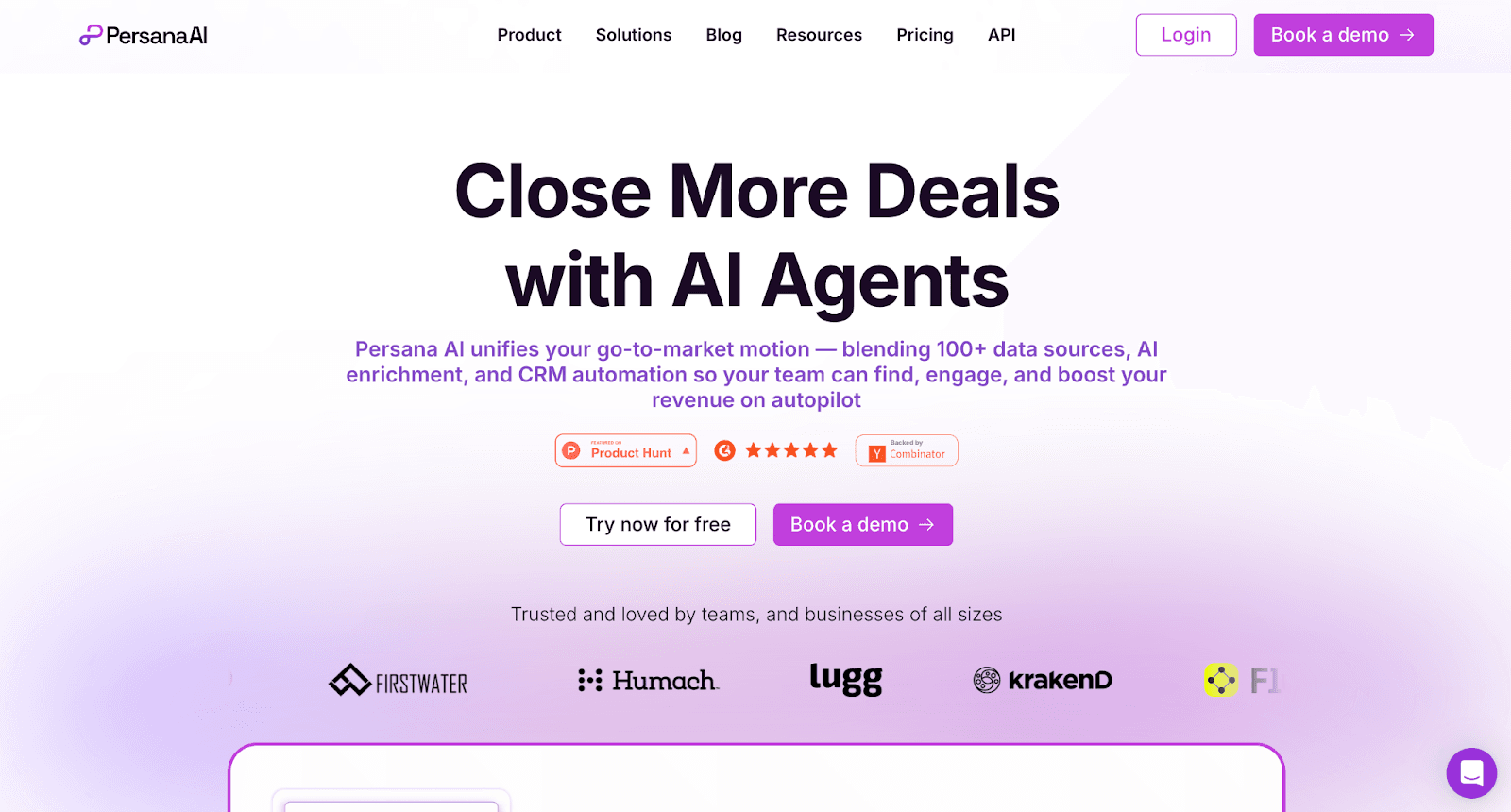
Best For: High-growth sales organizations that require deep personalization and signal-based selling to execute hyper-targeted outreach campaigns.
Why It Stands Out: Persana AI is a sales intelligence platform that excels at turning data into actionable outreach. Its key strength lies in its ability to monitor over 75 buying intent signals, such as funding announcements, hiring surges, and technology changes. This allows sales teams to engage prospects at the perfect moment with a hyper-relevant message. With a database of over 700 million contacts and a powerful waterfall enrichment system, Persana ensures your team has accurate data to fuel its campaigns. Its AI-powered personalization can generate messages that achieve significantly higher open rates than generic templates.
Pros:
- Excellent for signal-based selling and identifying in-market buyers.
- AI-powered personalization creates highly relevant outreach copy.
- Large contact database with a strong email find rate.
- Credit rollover system provides good value.
Cons:
- Has a steeper learning curve than simpler automation tools.
- The credit-based model can be complex for some users to manage.
- Requires internal resources to build and manage campaigns.
5. Clay
Type of Service: Platform (Tool)
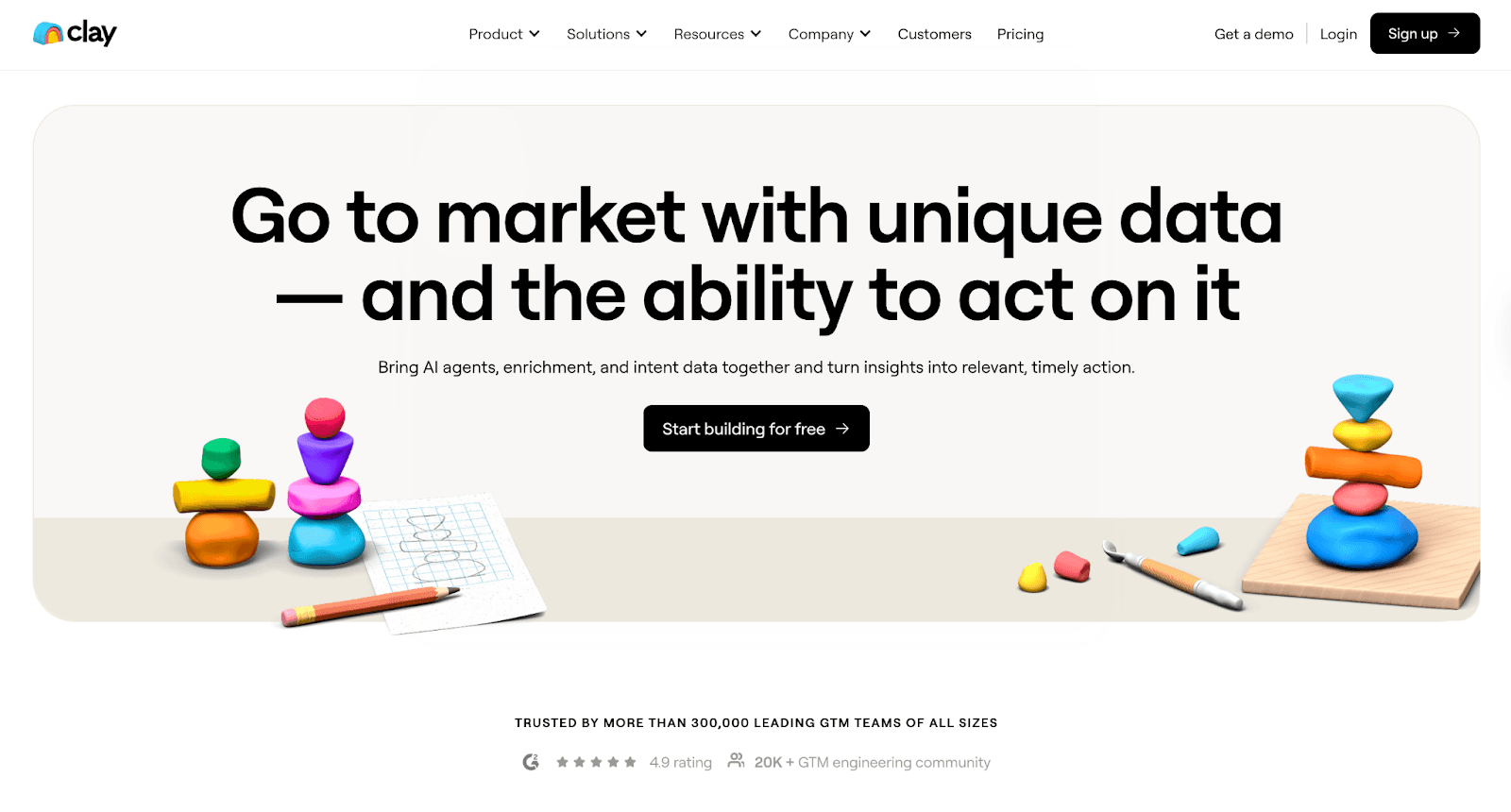
Best For: Revenue Operations (RevOps) and growth teams that need to perform deep, customized data enrichment and automate complex research workflows.
Why It Stands Out: Clay is a data automation platform that functions like a spreadsheet on steroids. It's designed for teams that prioritize deep research and data quality. Its standout feature is waterfall enrichment, which queries over 150 data providers to find accurate information. Clay’s AI agents ("Claygents") can automate research tasks that would otherwise take hours, such as finding specific information on a company's website or summarizing a prospect's recent LinkedIn activity. While it doesn't have built-in outreach capabilities, it integrates seamlessly with tools like La Growth Machine and email senders, providing the data foundation for sophisticated campaigns.
Pros:
- Unparalleled data enrichment and research capabilities.
- Highly customizable workflows for complex go-to-market strategies.
- AI agents automate time-consuming manual research.
- Integrates with a wide range of sales and marketing tools.
Cons:
- Steep learning curve required to master its advanced features.
- No native outreach functionality; must be paired with other tools.
- Credit-based pricing can be difficult to predict.
6. SPOTIO
Type of Service: Platform (Tool)
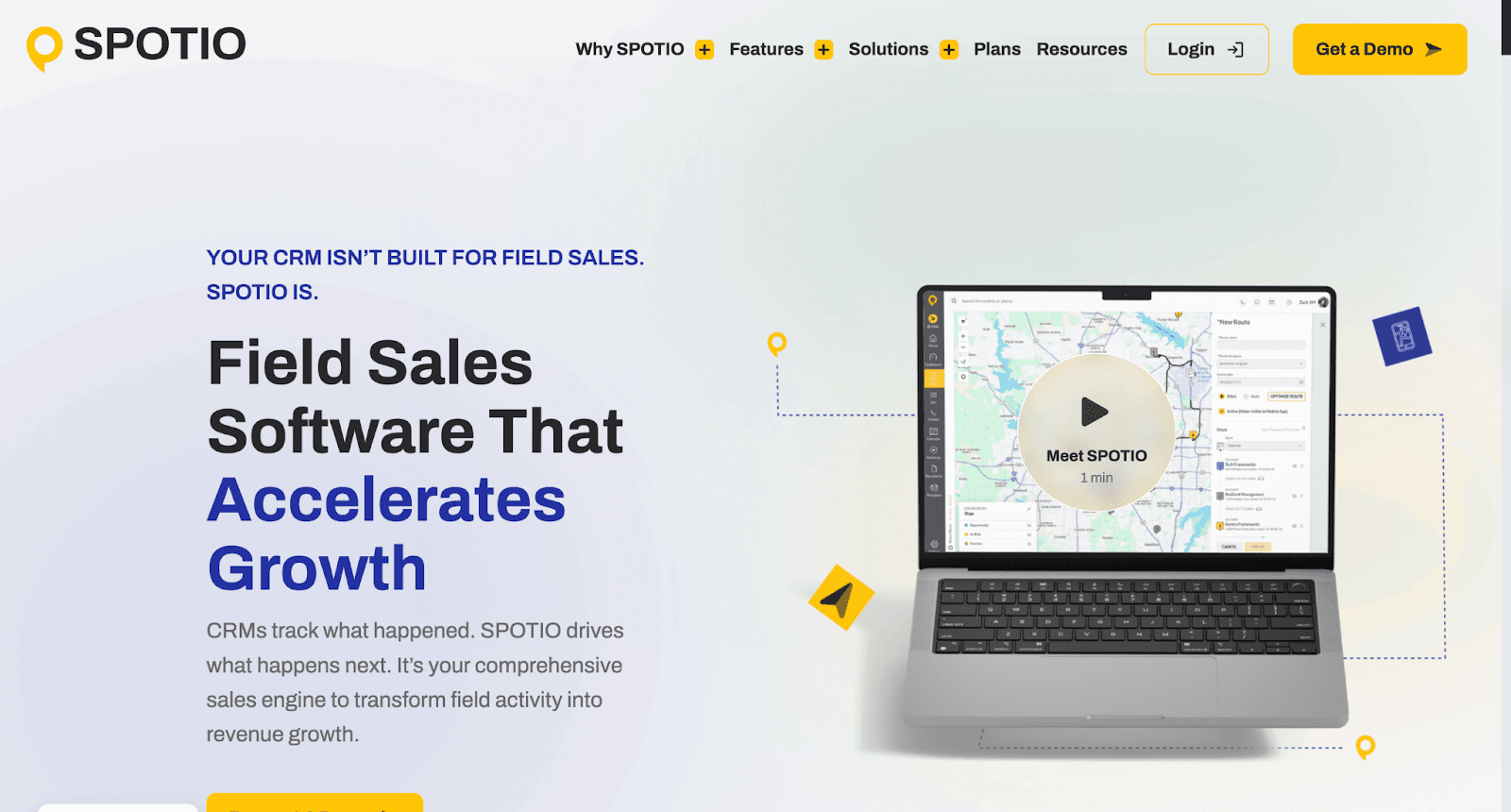
Best For: Field sales teams needing to optimize territory management, route planning, and mobile activity logging.
Why It Stands Out: While many sales automation tools are built for inside sales, SPOTIO is designed specifically for reps on the road. It addresses the unique challenges of field sales, such as wasted drive time and a lack of visibility into on-the-ground activities. SPOTIO, similarly to Repsly and its alternatives, offers automated territory management, route optimization, and one-tap, location-verified activity logging. Its offline mode ensures that reps can continue to work and log activities even without an internet connection, syncing the data later. For any business with an outside sales component, SPOTIO is essential for maximizing efficiency and accountability.
Pros:
- Specialized features for field sales, including route and territory optimization.
- Robust mobile app with offline functionality.
- Automates activity tracking with GPS-stamped logging.
- Integrates with major CRMs like Salesforce and HubSpot.
Cons:
- Niche focus makes it less suitable for purely inside sales teams.
- Some features may be overkill for smaller field teams.
7. La Growth Machine
Type of Service: Platform (Tool)
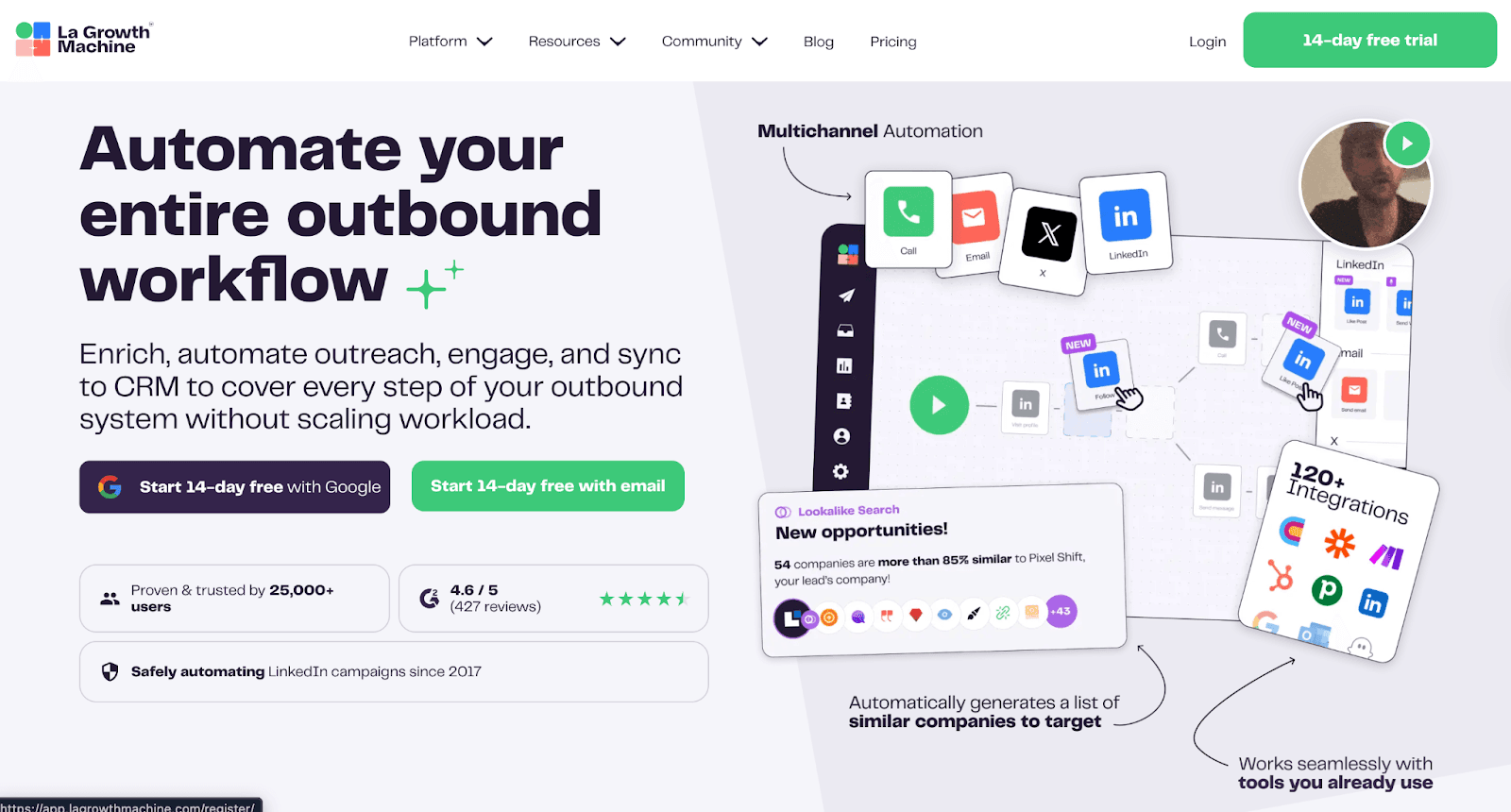
Best For: B2B sales teams wanting to execute multichannel prospecting campaigns at scale, particularly those leveraging LinkedIn.
Why It Stands Out: La Growth Machine is an all-in-one multichannel prospecting platform that automates outreach across LinkedIn, email, voice messages, and X (formerly Twitter). Its greatest strength is its deep LinkedIn integration, allowing users to send automated voice messages, perform social warming (auto-likes and follows), and target prospects based on LinkedIn intent data (e.g., people who liked a certain post or attended an event). Its waterfall email enrichment ensures high data accuracy, and the unified inbox centralizes all conversations, making it a powerful tool for teams looking to boost reply rates beyond email-only campaigns.
Pros:
- True multichannel automation in a single, unified sequence.
- Exceptional LinkedIn capabilities, including unique features like voice messages.
- User-friendly for beginners but powerful enough for experts.
- All-inclusive pricing with no hidden fees for enrichment or CRM sync.
Cons:
- Primarily focused on B2B prospecting.
- Requires a LinkedIn account to unlock its full potential.
8. Utmost Agency
Type of Service: Sales Automation & Outbound Agency
Best For: B2B companies seeking to build intelligent sales systems focused on automation, rather than simply adding headcount.
Why It Stands Out: Utmost Agency is recognized for its systems-first approach to sales automation. Rather than hiring more sales reps, Utmost specializes in building automated outbound infrastructure and workflows that scale. They're experts at using platforms like Clay to set up pipelines driven by data, intent signals, and real-time buying triggers. The team excels at combining AI-powered research, data enrichment, and perpetual lead generation to find buyers at the exact moment they enter a buying window. This makes them an ideal partner for tech-forward companies looking to create sustainable, multi-channel engines for pipeline growth.
Pros:
- Deep expertise in building scalable, automated sales infrastructure.
- Mastery of intent data, workflow automation, and advanced data enrichment tools.
- Emphasis on predictable pipeline creation, not just temporary lead boosts.
- Strong experience in system integration and custom workflow design.
Cons:
- May not be the best fit for organizations looking for traditional SDR staffing models.
- Requires a collaborative approach and alignment on systems philosophy.
- Companies seeking "out-of-the-box" solutions may face a learning curve with Utmost’s tailored systems.
9. Zapier
Type of Service: Platform (Tool)
Best For: Non-technical teams who need to connect different applications and automate simple, trigger-based workflows without writing code.
Why It Stands Out: Zapier is the "glue" of the internet. While not a dedicated sales automation tool, it is an essential component of many modern sales tech stacks. It allows you to connect over 8,000 different apps and create automated workflows, or "Zaps," based on triggers and actions. For example, you could create a Zap that automatically adds a new lead from a form submission to a Google Sheet, enriches the contact data via another service, and then adds it to your CRM. For sales teams using multiple, disconnected tools, Zapier is invaluable for eliminating manual data transfer and creating seamless processes.
Pros:
- Incredibly easy to use with no coding skills required.
- Massive library of integrations connecting almost any tool.
- Saves significant time by automating repetitive data entry tasks.
- Flexible and scalable, from simple two-step Zaps to complex, multi-path workflows.
Cons:
- Pricing is based on the number of tasks, which can become expensive for high-volume workflows.
- Reliability depends on the APIs of the connected apps.
- Not suitable for highly complex, enterprise-grade integrations.
10. Sopro.io
Type of Service: Agency (Service)
Best For: B2B companies looking for a managed outbound prospecting solution and a steady stream of qualified leads.
Why It Stands Out: Sopro.io specializes in fully managed, compliant outbound email campaigns tailored for B2B sales teams. They take care of audience research, campaign setup, personalized outreach, deliverability management, and response handling. Sopro’s expert team ensures every step of the outreach process is handled, delivering conversation-ready leads directly to your sales or business development team. Their transparent reporting and data-driven approach help businesses consistently fill the sales pipeline without heavy internal involvement.
Pros:
- Complete, done-for-you outbound prospecting service.
- High standards of compliance with GDPR and global privacy laws.
- Dedicated account management and expert copywriting.
- Real-time reporting and visibility into campaign performance.
- Integrates with most CRM systems for seamless lead handoff.
Cons:
- Less control for teams that prefer in-house campaign execution.
- Best suited for companies focused on email-based B2B demand generation.
- Pricing model may be out of reach for very early-stage startups.
The Core Benefits of Sales Automation
Implementing a sales automation strategy, whether through a tool or an agency, delivers tangible benefits that go far beyond just saving time. By automating administrative tasks, you free up your sales team to focus on high-value activities like giving demos, negotiating contracts, and building customer relationships.
Automation ensures that every lead receives timely and relevant follow-up, preventing opportunities from falling through the cracks and nurturing leads until they are sales-ready. This leads to higher conversion rates and a more efficient sales process overall.
Modern tools also allow for enhanced personalization at scale. You can send highly relevant messages to a large audience based on their behavior, industry, or specific pain points, creating more meaningful engagement with potential customers.
Furthermore, automated systems offer greater scalability. They can handle a growing volume of leads without requiring a proportional increase in headcount, making them an invaluable asset for growing businesses.
Finally, these platforms provide detailed analytics, enabling data-driven decision-making. You can use these insights to identify bottlenecks and continually optimize your sales strategy for better results.
How to Choose the Right Sales Automation Partner
With so many options available, selecting the right service can be challenging. Use these criteria to guide your decision:
- Define Your Needs (Agency vs. Tool): First, determine if you need a "done-for-you" service or a "do-it-yourself" tool. If you have a skilled in-house team with the bandwidth to manage campaigns, a platform like HubSpot or Persana may be a good fit. If you want to outsource the entire process to experts and simply receive qualified meetings, a done-for-you service is the better choice.
- Look for Industry Expertise: Does the provider have experience in your industry? A partner who understands the nuances of your market will be far more effective at crafting messaging and identifying the right prospects.
- Check for Integrations: Ensure the service or platform integrates seamlessly with your existing CRM and other critical tools. A lack of integration creates data silos and manual work, defeating the purpose of automation.
- Evaluate the Onboarding and Support: A powerful tool is useless if your team doesn't know how to use it. Inquire about the onboarding process, training resources, and ongoing customer support. For agencies, ask about their communication cadence and reporting structure.
- Focus on ROI, Not Just Price: Don't let cost be the only deciding factor. A cheap tool that fails to deliver results or a low-cost agency that provides poor-quality leads will cost you more in the long run. Calculate the potential return on investment based on the value of the leads or appointments generated.
Start Automating Your Pipeline with the Right Partner
Your sales team's most valuable asset is their time. Wasting it on manual prospecting and administrative chores drains resources, hurts morale, and stalls growth. The best partners transform lead generation from a burdensome task into an intelligent, automated engine for predictable growth.
The strongest partners don't just sell you software; they become a strategic partner, building and managing your entire outbound system - from technical setup and data enrichment to campaign execution and inbox management - generating the opportunities so your closers can do what they do best: close.
Ready to see how an AI-powered, done-for-you outbound strategy can fill your calendar with qualified meetings? Book a free strategic call today.


