
A cold email lands differently when the person reading it has already seen your ads and read your content. That gap between a stranger and a familiar name is what account-based marketing is built to close.
We ran the motion below for one client and it brought in more than $2M in closed-won. It syncs three channels (paid ads, organic content, and outbound) so each one makes the next one land harder.
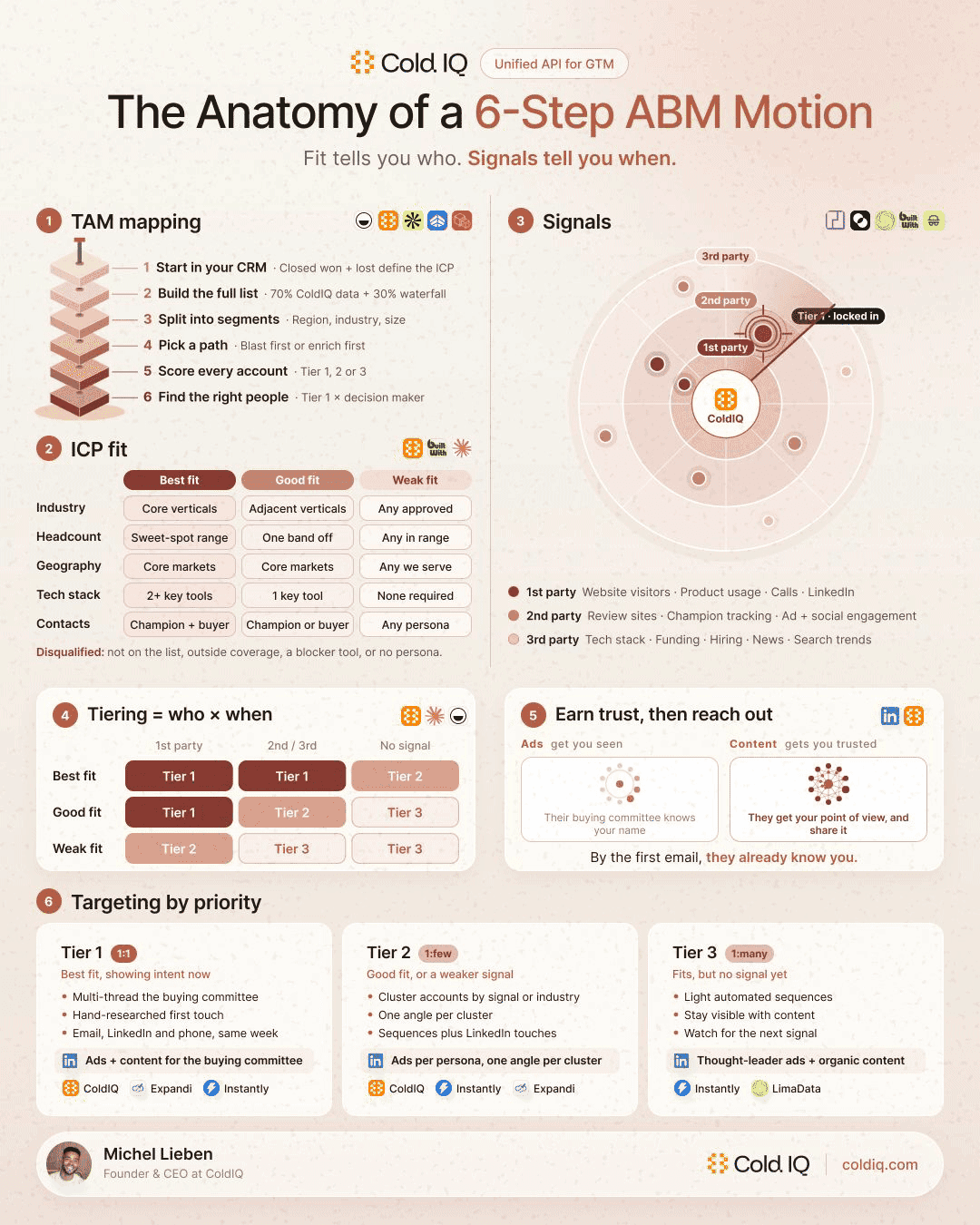
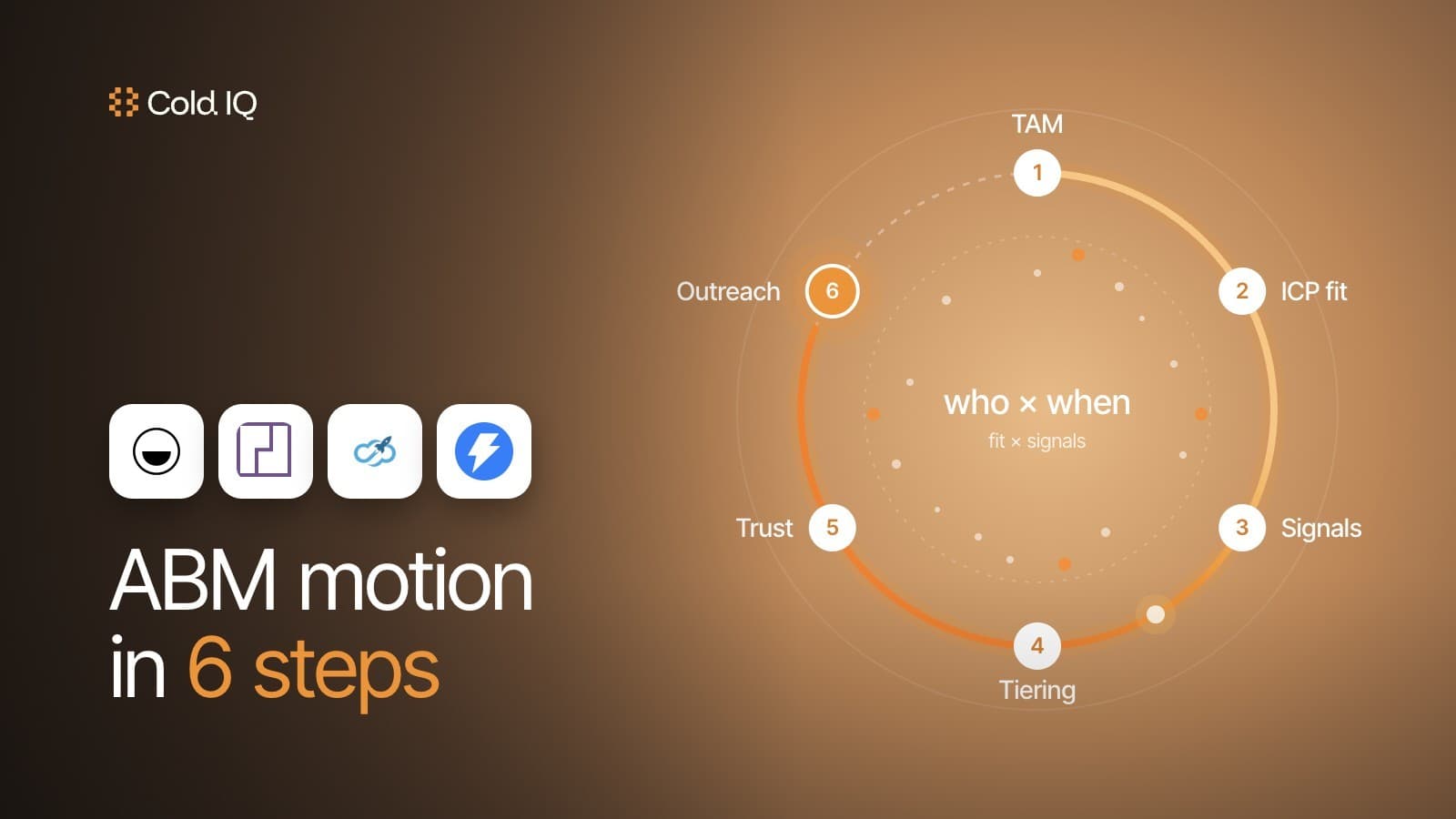
The whole system rests on one idea. Fit tells you who to go after. Signals tell you when.
The six steps below follow the same shape. Each one covers why the step matters, how we run it, and what it hands to the next step. Skim the shape, or read each step in full.
TAM Mapping Starts in Your CRM
Why it matters: an ABM motion is only as good as the account list underneath it. Build the list on guesswork and every later step, from scoring to ad spend, compounds the error.
How we run it: start with the deals you already have. Closed-won deals show you who buys, and closed-lost deals show you who looks like a buyer but walks away. Together they define the ICP more honestly than any persona workshop.
We use folk as our CRM, so that is where the analysis starts. From there we build the full market list. Roughly 70% of it comes straight from ColdIQ data, and the remaining 30% runs through a waterfall of providers to fill the gaps.
Then the list gets split into segments by region, industry, and company size. Each segment gets its own path: blast first and learn from replies, or enrich first and go slower with more context.
What it hands off: a full, segmented account list, with a path chosen for each segment.
If you want to grow the list from the customers you already win with, start from their lookalikes.
You can find companies that match your best customers, for free:
Lookalike Finder Tool
Fields marked with * are required
Quick examples:
ICP Fit Is a Grade, Not a Yes or No
Why it matters: a flat list treats a perfect-fit account and a long shot the same way. They get the same budget, the same sequence, and the same SDR time. Grading every account fixes that before any money is spent.
How we run it: score each account on five criteria. Industry, headcount, geography, tech stack, and contacts.
A best-fit account sits in a vertical where you already win, at the headcount where your deals close, in a market you serve well. It runs 2 or more of the tools that make your product a must-have, and you have identified both a champion and a buyer inside it.
A good-fit account is one step off on a criterion or two. An adjacent vertical, one headcount band away, a single key tool in place, or a champion without a buyer yet.
A weak-fit account clears the basic bar and nothing more. It sits in an approved industry and a market you can serve, with any persona you can reach.
Then there is the disqualified pile. An industry you do not sell to, a market you cannot serve, a competitor already locked in, or nobody matching your buyer. These come off the list entirely.
What it hands off: every account carries a fit grade, best, good, or weak.
The tech stack criterion takes real data to check, and it often decides whether an account is a good fit or a best fit.
You can check which tools any company runs, for free:
Tech Stack Finder Tool
Quick examples:
Signals Tell You When to Move
Why it matters: fit is static. A best-fit account can be a terrible target this month if it has no reason to buy. The goal is to get in front of prospects as soon as they start looking for your use case.
How we run it: we track signals in three layers.
First-party signals come from your own channels: website visits, product usage, calls, and LinkedIn activity. They are the strongest, because the account is already interacting with you.
Second-party signals come from platforms around you: review sites, champion tracking when a past user changes jobs, and engagement with your ads or social posts.
Third-party signals come from the open market: funding rounds, hiring, tech stack changes, news, and search trends.
The payoff is measurable. Snowflake found that prospects flagged as high intent converted 4x better than the average account in their CRM.
We track all three layers through ColdIQ, which routes each signal type to the provider that covers it best. Ad intelligence goes to Adyntel. Job changes go to PredictLeads.
What it hands off: every account carries a signal status, first-party, second or third-party, or no signal yet.
You can see which companies in your market are showing buying signals right now, for free:
Intent Signals Tool
Fields marked with * are required
Quick examples:
Tiering Crosses Who With When
Why it matters: fit and signals are useless on their own. A best-fit account with no signal can wait. A good-fit account showing first-party intent cannot. Tiering combines both into one decision about where effort goes.
How we run it: lay the fit grade against the signal status in a simple grid.
A best-fit account with any signal, first, second, or third-party, goes straight to Tier 1. A good-fit account showing first-party intent joins it there.
Tier 2 holds best-fit accounts with no signal yet, good-fit accounts with a weaker second or third-party signal, and weak-fit accounts showing first-party intent.
Tier 3 is everything else. Good fit with no signal, or weak fit with no first-party activity.
The grid is a living thing. Accounts move up the moment a new signal fires, which is why signal tracking has to run continuously and not as a one-off enrichment.
What it hands off: every account sits in Tier 1, 2, or 3, and that tier decides how it gets worked.
Earn Trust Before You Reach Out
Why it matters: the first email should never be the first time someone hears your name. Ads get you seen by the buying committee, and content gets you trusted. By the time the first email lands, they already know who you are.
How we run it: start with thought-leader ads on your target accounts. These are ads that run from a founder or expert profile, so they read like a post from a person and not a banner from a brand.
Then watch who engages. Cold accounts stay in awareness and keep seeing ads. Accounts that keep engaging move to consideration. Warm accounts get outbound and retargeting.
Snowflake calls its version of this the "1-2 punch". Two weeks of ads, emails, and personalised landing pages or custom microsites come first, and only then do SDRs step in.
What it hands off: a buying committee that recognises your name before anyone from your team writes to them.
We broke down how ads, content, and outbound work together in more detail in the 4-channel ABM system behind $7.8M in pipeline.
Targeting by Priority
Why it matters: each tier deserves a different level of effort. Treating all three the same either burns budget on Tier 3 or starves Tier 1.
How we run it: each tier gets its own model.
→ Tier 1 (1:1): multi-thread the buying committee across every channel in the same week. The first touch is hand-researched, and email, LinkedIn, and phone all run together.
→ Tier 2 (1:few): cluster accounts by signal or industry, with one angle per cluster. Sequences run alongside LinkedIn touches.
→ Tier 3 (1:many): light automated sequences and thought-leader ads, staying visible with content until the next signal fires.
Across all three, tailor every ad and landing page to the persona and the account. Then shift the message as the account moves through the buying journey.
For AirOps, outbound led with value. Webinar invitations, requests for input, and role-based sequences ran across the whole buying group. We wrote the full story in how we built an ABM campaign that generated $3M in pipeline for AirOps.
For sending, we use Expandi for LinkedIn and Instantly for email. Tier 3 leans on Instantly sequences, with LimaData supplying the LinkedIn data behind them.
What it hands off: a pipeline where each account gets the level of attention its fit and timing deserve.
Multi-threading a Tier 1 account only works if you know who sits on the buying committee.
You can map the decision makers inside any target account, for free:
Find People Tool
FIND PEOPLE
Type domains, select personas, fetch real contacts.
Paste a LinkedIn company URL or company domain and press Enter
Persona 1
Define specific job titles to target the right decision makers
Why ABM Pays Off When the Steps Connect
Each step on its own is familiar. CRM analysis, ICP scoring, intent data, ads, outbound. The results come from wiring them together, so the output of one step decides what happens in the next.
The CRM defines the ICP. The ICP grades every account. Signals decide timing. Tiers decide effort. Ads and content warm the account up, and outbound arrives when the name is already familiar.
When it runs that way, ABM pays off big. For a deeper look at the strategy side, with templates, see our ABM strategy guide.
If it feels like too much to build at once, that is the part we help teams implement.