
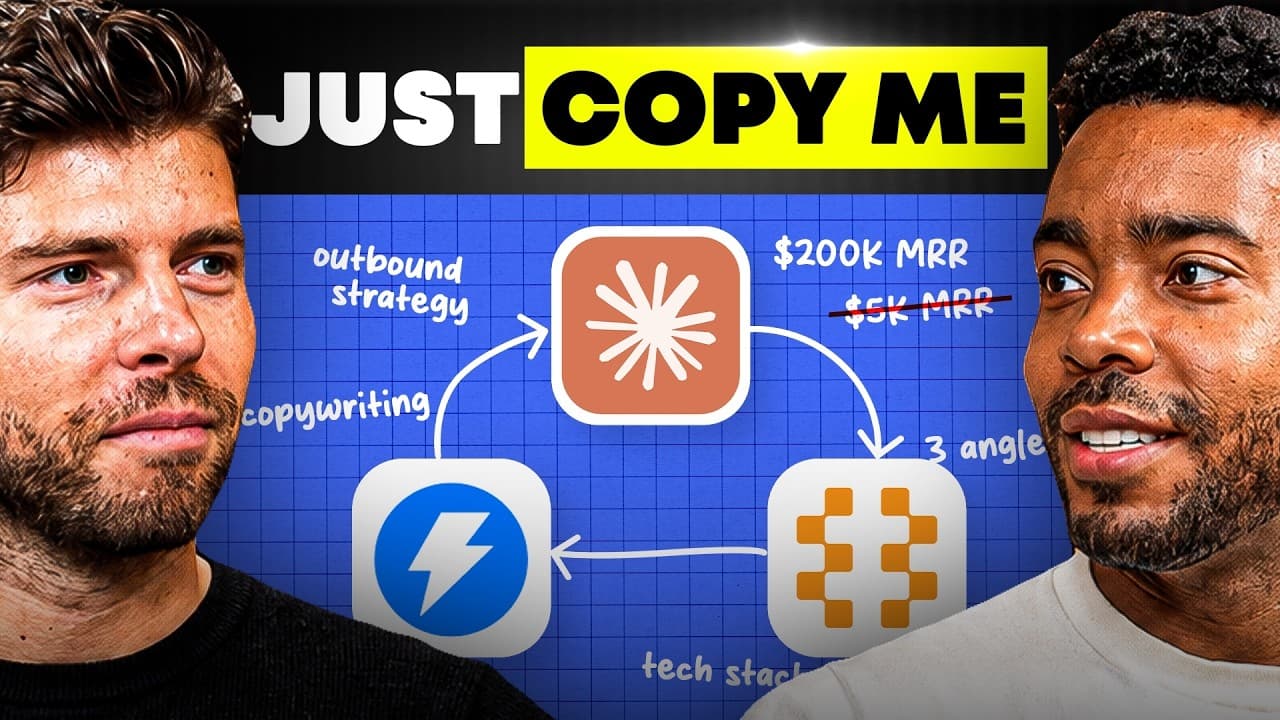
Thibault runs For Digital Sakes, a digital agency that builds launch strategies and videos for hotel and tech brands. Inbound already works for them. Thibault and his co-founder Holly grew their LinkedIn audiences to 16,000 and almost 20,000 followers, and the leads keep coming in.
What they did not have was a way to choose who they work with. As Thibault put it, he wanted to be "more intentional or more proactive on who I reach out to and not just waiting on whoever comes to me."
So we sat down for an hour and built three outbound campaigns live, with AI agents doing the heavy lifting. Each campaign starts from a situation a buyer is in right now, and each one is broken down below in the same shape: the trigger, who gets the email, what the agent wrote, and what we changed after reading it.
Why an Inbound Agency Still Needs Outbound
Content brings you whoever happens to see it. That is a good flow, but you do not pick the segment, and you cannot turn the volume up when you need more of one type of client.
For Digital Sakes had three audiences in mind. Hotels opening new locations came first, because pre-openings are a real need, the agency has done them for big brands, and few agencies specialise in them. Hotel tech brands came second. Thibault's read on them: "they have a beautiful product... they just don't know how to market it." B2B tech brands came third, for the same reason. Building a good product got easier, so the game moved to distribution.
Before touching any tool, we checked the volume. Hundreds of hotels opening, three or four relevant people at each one, and an even larger pool on the tech side. That means thousands of emails, and thousands of emails only land if the infrastructure is ready for them.
The Infrastructure Comes First
You cannot send many emails per mailbox anymore, so you spread the volume. You buy secondary domains (variations of your main domain), create mailboxes on each one, and send a few emails from every mailbox.
We buy from more than one provider to limit the risk. We have used Hypertide a lot for domains and mailboxes, and we mix Google Workspace with Microsoft so that if one system underdelivers, the other keeps sending. We also added Holly as a sender next to Thibault. Depending on who you target, we sometimes see women get more replies than men.
Then you wait. New mailboxes need at least two weeks of warmup. Warmup pools make mailboxes send to each other, and when an email lands in spam, the receiving mailbox pulls it back to the inbox. After enough repetitions, Google and Microsoft learn that your mail belongs in the main folder.
We have written about deliverability in depth, so we will keep this short. If you want the full checklist, start with how to avoid the spam folder for cold emails.
Claude Code as the Orchestration Layer
We ran every campaign from Claude Code. You describe what you want in plain language, typed or spoken, and the agent works out which actions to take.
The catch is data. The best B2B data sits behind paywalls, so an agent that has to build a list of hotel general managers needs paid access to a database. You either pay for a pile of subscriptions, or you connect one unified API that routes each task to the right provider.
That routing is what we built into the ColdIQ MCP. Ask for CEOs in an industry that are hiring and growing fast, and the agent calls Apollo to build the list and PredictLeads for the hiring signal. It then pulls emails from Prospeo and phone numbers from FullEnrich. Connecting it takes one copy-pasted command.
For sending, Instantly handles email and Expandi handles LinkedIn. We used Instantly for all three campaigns here.
The last piece is the copy. Our cold email skills are built from what we learned working with 300+ B2B clients while growing the agency from 0 to $7M a year. When the agent writes, it writes from templates and frameworks that have already performed.
Hotels Opening Their Doors in 3 to 18 Months
The trigger: a hotel announcing a new location. When a hotel opens, it has a budget for launch marketing, and it needs that marketing to exist before the doors open. Claude Code can monitor the news through tools like Linkup, Jina and Exa, so the agent first builds a list of hotel companies, then finds the ones with openings coming up. We started with 6 to 12 months and widened it to 3 to 18.
Who gets the email: the general manager or the managing director first, since the managing director of a region often decides who handles the opening. If neither shows up, the marketing director or sales director. For boutique and independent hotels, the owner directly, because decisions move much faster there. Every contact has to sit in the same location or region as the opening, since a general manager is usually on site.
The agent finds around three people per hotel. Finding the right people inside a target account is the step that decides whether the email reaches someone who can say yes.
You can pull the people working at any company you target here, for free:
Find People Tool
FIND PEOPLE
Type domains, select personas, fetch real contacts.
Paste a LinkedIn company URL or company domain and press Enter
Persona 1
Define specific job titles to target the right decision makers
What the agent wrote: Mich dictated the whole brief in one go with Aqua Voice. The structure follows a simple anatomy. You open with a specific situation, which gives you a reason to reach out, then back it with proof from big brands, and you close on an ask that is easy to say yes to.
That last part matters. A hotel general manager gets plenty of meeting requests. Asking "can I send you a few sample videos we made for similar hotels?" costs them nothing and does not force a call. Thibault's videos sell themselves, so the samples carry the pitch.
The brief also included one personal touch. If the agent finds a colleague who might own launch marketing, it names them: "If [colleague] owns launch marketing instead, happy to talk to them." Here is the first email after our fixes, as it showed up in Instantly:
Hi [first name], saw [hotel] is opening in [month]. Hope this is relevant to you. If [colleague] owns launch marketing instead, happy to talk to them. We're For Digital Sakes. We run the full pre-opening strategy (branding, ads, SEO and content) before the hotel is ready. We turn renders into lifestyle images, and once the hotel is ready, we shoot the films. We've worked with Bulgari, Belmond and Rosewood. Is your launch strategy already covered?
What we changed: the first draft said the agency "shoots pre-opening films." Thibault flagged it straight away. During a pre-opening, the hotel is not built yet, so there is nothing to shoot. The real offer is the digital strategy before the opening, with renders turned into lifestyle images, and the shoot comes later. We also told the agent to drop the colleague line entirely when it could not find a real name.
Both fixes went in by asking the agent in plain language, and the campaign in Instantly updated itself.
The Quick-Math Follow-Up
The second email came from something Thibault's team already does in sales calls. They reverse-engineer what success looks like for the hotel. An opening has an occupancy goal and an average daily rate (ADR). From there you can work out how many bookings the hotel needs, how much of that should come direct rather than through OTAs, how much website traffic that takes, and how many video views produce that traffic.
We asked the agent to run that math for each prospect. For a Mandarin Oriental property opening in 2027, the first draft started from 108 keys at 60% occupancy over the first six months. That is about 11,800 room nights, or around 4.7K bookings at an average stay of 2.5 nights. It carried the chain through direct bookings, website conversion, the share of traffic from social and the click-through rate, and landed on roughly 4.4 million video views. It closed by asking for a short call to pressure-test the numbers.
Thibault liked the format and corrected one input: "60% for an opening is quite ambitious." He put the realistic ceiling at 40%. The revised email landed on roughly 2.9 million video views.
Then we tied the number to proof. Once the email says how many views the hotel needs, the next line can point to a Bulgari video the agency made and offer to walk the prospect through how it performed. One caution here: Thibault was not sure of that video's exact view count during the session, so the figure has to be checked against the case study before the campaign goes out. An agent will write whatever number you hand it.
The math is the part that makes this email hard to ignore. A general manager reading their own occupancy, booking and traffic numbers sees work done for them specifically.
Every fix in this campaign tightened the copy without making it longer. Thibault wanted to add that the agency builds waiting lists before the opening. Mich's answer: "The issue with cold emails is that we always want to add more more more." The email only has to earn the call, and the call does the convincing.
If you want to tighten your own sequence the same way before it ships, you can do it here, for free:
Email Copy Optimizer Tool
Business email required to use the tool
The first run found nine contacts. We asked for 100 more, and asked the agent to spin up sub-agents for a separate boutique hotel campaign aimed at owners. By the end of the session, the main campaign had around 50 new contacts and was still filling, and the boutique campaign had 48 owners loaded.
B2B Launches That Fell Flat
The trigger: a B2B company that announced a launch on LinkedIn, X or Product Hunt, and the launch underperformed. The logic is an educated guess. A weak launch post means few people saw it, and few people seeing it means the launch probably did not go well. Mich set the bar at fewer than 30 likes on LinkedIn, or finishing towards the bottom of the day on Product Hunt.
Who gets the email: revenue leaders, meaning the founder, CEO, or a marketing, sales or business development director. A flopped launch alone does not mean they can pay, so the brief added a budget check. The company needs at least 20 employees, or, if it is new, it needs to have raised funding. Funding is a qualifier here rather than the trigger.
What the agent wrote: the brief was deliberately vague, to see what the agent would do with it. It came back with companies and their numbers. One was a public company with around 2,300 employees that finished 31st on Product Hunt with 58 upvotes. Another finished 25th with 18 upvotes. The email:
Hi [first name], you launched [product] on Product Hunt on [date]. It finished [rank] for the day with [upvotes] upvotes. That usually says more about distribution than the product. Most of your buyers probably still haven't seen it. We're For Digital Sakes. We make launch videos for big tech brands and we guarantee 20,000+ views. Worth a chat about giving [product] a second launch?
What we changed: Thibault raised a fair point. A company that already launched may have already paid for a video, which leaves only the distribution half of the service to sell. Mich's answer was to split the angle rather than kill it. A two-line LinkedIn post from an engineering team with no video is a different situation from a polished launch that reached nobody, and each deserves its own campaign. On LinkedIn, the email could also borrow Thibault's own proof, since several of his posts have passed 100,000 views.
This is the real lesson of the session. You run several angles side by side, see which one lands, and load the winner with as many leads as you can find.
Pitching the Competitors of a Launch
The trigger: Thibault suggested this one. Find a company that launched something, successful or not, then email its competitors. A competitor's launch is a reason for a founder to care about their own visibility this week.
Who gets the email: the same revenue leaders as the previous campaign, at companies that compete with the one that launched. To find them, the agent uses lookalike search through PredictLeads and other providers in the marketplace.
Finding competitors is the step that turns one launch into a list of a dozen relevant companies.
You can find companies similar to any account you already know, for free:
Lookalike Finder Tool
Fields marked with * are required
Quick examples:
What the agent wrote: the email estimates the reach of the competitor's launch and offers to beat it.
Hi [first name], your competitor [company] launched [feature] on LinkedIn on [date]. The post got 94 reactions. Rough math, that's around 4.7K people who saw it, and maybe 470 fit the buyer profile you sell to. Pretty sure we could beat that launch for [their company]. We're For Digital Sakes. We make launch videos for tech brands and we guarantee 10,000+ views. Can I walk you through how we'd do it for [their company]?
What we changed: the first email worked. The second email spent most of its length explaining how the reach estimate was calculated, which repeats the first one. That is the next fix, and like every other fix in this session, it is one sentence to the agent.
Run the Angles Side by Side
By the end of the hour, four campaigns sat in Instantly: big hotel pre-openings, boutique hotel pre-openings, flopped launches and competitor launches. Keeping big chains and boutique hotels in separate campaigns was deliberate. It lets you compare reply rates between the two segments instead of averaging them away.
The working pattern is what makes this fast. You give one agent a detailed brief, and while it searches, you write the brief for the next campaign. You come back, read the emails as they will be sent, fix what is wrong in plain language, then ask for more leads.
None of this replaces the judgement Thibault brought. The agent wrote "we shoot pre-opening films" and a 60% occupancy rate. Only someone who runs hotel openings knew both were wrong. The agent saves the hours. The person who knows the market makes the copy true.
This is also the second time we have worked with Thibault. The first session was about LinkedIn growth, and you can read the full LinkedIn content blueprint we built with him. If you want to see a different build of the same workflow, here is how Claude Code builds an entire outbound campaign in under 20 minutes.
Each campaign here started from a situation rather than a filter, and that is the part worth stealing. With a few of these situations mapped to your ICP, you can find your next angle here, for free:
Campaign Ideation Tool
Enter your email to generate your campaign ideas.